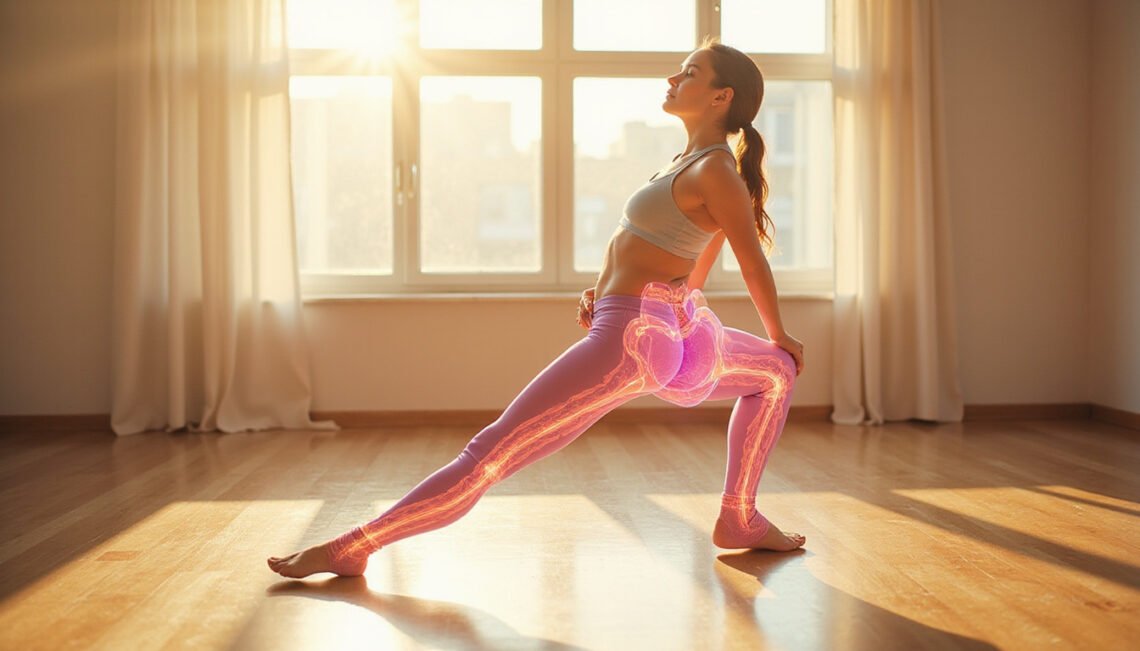
If you sit a lot, run, lift, or struggle with tight hips and a sore lower back, building a simple psoas stretch routine can be a game-changer. The psoas (properly, the iliopsoas) is a deep hip flexor muscle that connects your lower spine to your thigh bones. When it’s tight or overworked, it can tug on your lumbar spine, tilt your pelvis, and limit hip extension—often showing up as hip stiffness, anterior pelvic tilt, or nagging lower back pain.
This guide walks you step-by-step through an effective, beginner-friendly psoas stretch routine to improve hip mobility, reduce tension, and support a healthier back.
Why the psoas matters for hip mobility and lower back pain
The psoas is one of the only muscles that connects your spine directly to your legs. It:
- Originates from the lumbar vertebrae (lower spine).
- Runs through the pelvis.
- Attaches to the lesser trochanter of the femur (upper inner thigh).
Because of this unique pathway, the psoas:
- Flexes the hip (brings your thigh toward your torso).
- Stabilizes your spine during standing, walking, and running.
- Influences pelvic position (anterior/posterior tilt).
When it’s chronically tight:
- You may feel tightness in the front of the hip.
- Your pelvis may tilt forward, increasing the arch in your lower back.
- You can experience compressive stress on the lumbar spine, contributing to discomfort or pain.
Prolonged sitting, repetitive hip flexion (like cycling or running), weak glutes, and poor posture can all lead to a shortened, overactive psoas. That’s where a well-designed psoas stretch routine comes in—paired with strengthening of supporting muscles.
Before you start: key safety tips for psoas stretching
A few basics to keep your routine safe and effective:
- Never force a stretch. You should feel mild to moderate tension, not sharp or pinching pain.
- Breathe slowly and deeply. The psoas responds to nervous system tension; relaxed breathing helps it release.
- Focus on alignment. Poor form often leads to stretching other areas (like your lower back) instead of the psoas.
- Go slow. Hold each stretch long enough (30–60 seconds) for tissues to adapt.
- Check in with your body. If you have existing back or hip conditions, consult a medical or physical therapy professional first.
Core psoas stretch: kneeling hip flexor stretch
This is the foundational static psoas stretch most people start with. It targets the hip flexors on the side of the trailing leg.
How to do it
-
Kneel on a mat
- Start in a half-kneeling position: right knee on the floor, left foot in front, knee bent at 90 degrees.
- Place hands on your front thigh for balance.
-
Find neutral pelvis
- Gently tuck your tailbone under (posterior pelvic tilt) as if you’re trying to zip up tight jeans.
- Engage your lower abs slightly—this prevents lower back arching.
-
Shift forward carefully
- Keeping your torso upright, slowly shift your weight forward until you feel a stretch in the front of the right hip and groin.
- Don’t let your lower back overextend.
-
Hold and breathe
- Hold 30–60 seconds, breathing deeply into your belly.
- You can reach the right arm overhead and slightly side-bend to the left to intensify the stretch.
-
Switch sides and repeat 2–3 times per side.
Common mistakes
- Arching the lower back instead of tilting the pelvis.
- Lunging too far forward so the front knee passes the toes excessively.
- Holding the breath, which increases overall tension.
Supine psoas stretch: supported leg drop
This variation lets your lower back stay supported on the floor, which is ideal if standing or kneeling is uncomfortable.
How to do it
-
Set up on a firm surface
- Lie on your back near the edge of a bed or a sturdy bench.
- Bring both knees toward your chest.
-
Lower one leg
- Slowly lower your right leg off the edge, letting it hang toward the floor.
- Keep left knee hugged close to your chest.
-
Maintain neutral spine
- Keep your lower back gently pressed toward the surface (avoid arching).
- You should feel a stretch in the front of the right hip and upper thigh.
-
Hold 30–60 seconds, relax into the stretch, then switch sides.
To intensify: slide your hips slightly closer to the edge or lightly extend the hanging leg without locking the knee.
Dynamic psoas stretch: lunge with arm reach
Static holds are great, but adding movement prepares your hips and spine for real-life activities.
How to do it
- Step into a long lunge with the right foot forward and left heel lifted.
- Slightly bend the back knee and gently tuck your pelvis under.
- Raise your left arm overhead and reach up and back while gently driving the left hip forward.
- Move in and out of a comfortable end range for 8–12 slow reps.
- Switch sides.
This dynamic psoas stretch is perfect as part of a warm-up for running, lifting, or sports.

Adding rotation: psoas stretch with trunk twist
Adding a twist can help mobilize the fascia and connective tissue around the psoas and torso.
How to do it
- Start in the kneeling hip flexor stretch position (right knee down, left foot forward).
- Find your pelvic tuck and gentle hip stretch first.
- Place your right hand on the floor or on a yoga block beside your right hip.
- Reach your left arm up and twist your torso gently toward the left knee.
- Hold 20–30 seconds, then release and repeat 2–3 times each side.
Keep your core lightly engaged to avoid collapsing into your lower back.
Simple daily psoas stretch routine (10–15 minutes)
Here’s a practical sequence you can use daily or 3–4 times per week to unlock hip mobility and ease lower back tension. Adjust hold times and sets based on your schedule and comfort.
-
Supine psoas stretch (supported leg drop)
- 2 × 30–45 seconds per side
-
Kneeling psoas stretch (hip flexor stretch)
- 2–3 × 30–60 seconds per side
-
Kneeling psoas stretch with side-bend and rotation
- 2 × 20–30 seconds per side
-
Dynamic lunge psoas stretch with arm reach
- 8–12 controlled reps per side
-
Counterbalance with light glute work
- 2–3 sets of:
- Glute bridges (10–15 reps)
- Side-lying clamshells (10–15 reps per side)
- 2–3 sets of:
Total: 10–15 minutes.
The glute exercises help support the changes you’re making by stretching the psoas—stronger glutes help keep the hips and pelvis in a healthier position.
Common signs you may need a psoas stretch routine
While only a professional can diagnose specific issues, many people with psoas tightness report:
- A feeling of pinching or tightness in the front of the hip, especially after sitting.
- Lower back stiffness or pain when standing up from a chair.
- Difficulty fully extending the hip while walking or running (short stride).
- Increased lower back arch when lying flat on your back.
- Relief when bringing knees toward the chest (temporary unloading of psoas tension).
If this sounds familiar, a consistent psoas stretch routine—paired with posture awareness and strength work—can be extremely helpful (and often more effective than occasional random stretching).
How long does it take to see results from psoas stretching?
Everyone’s timeline differs, but many people notice:
- Immediate short-term relief in perceived hip and back tension after a single session.
- Noticeable mobility gains within 2–4 weeks of consistent stretching (3–5 days per week).
- More durable improvements in posture and comfort when stretching is combined with strengthening and movement changes over 6–12 weeks.
According to the American Academy of Orthopaedic Surgeons, stretching and strengthening are core pillars of managing and preventing lower back pain (source: AAOS – Low Back Pain Exercise Guide).
Best practices to get more from your psoas stretches
To make your time count, focus on quality, not just quantity.
-
Warm up briefly first
A few minutes of light walking, stationary cycling, or hip circles help increase blood flow. -
Pair stretching with breathing
Inhale through the nose, exhale slowly through the mouth. On each exhale, let the body sink a bit deeper—without forcing. -
Avoid “front-of-hip jamming”
If you feel pinching in the actual hip joint rather than a lengthening in the front of the thigh and hip flexor area, reduce range or adjust your pelvic tilt. -
Don’t forget the opposite side
Even if one hip feels tighter, the psoas works on both sides to stabilize your spine. Balance is key. -
Stay consistent rather than intense
10 minutes a day of moderate, well-done psoas stretch work is more effective than a single, aggressive 45-minute session once a week.
Complementary strategies for lasting hip and back relief
Stretching is one piece of the puzzle. For longer-term change, combine your psoas work with:
-
Glute and core strengthening
Strong glutes counter excessive hip flexion, and a strong core supports spinal alignment. -
Less continuous sitting
Set a timer to stand and walk briefly every 30–60 minutes if your job is sedentary. -
Ergonomic adjustments
Ensure your chair, desk, and monitor heights encourage neutral spine and hips. -
Balanced training
If you run, cycle, or do a lot of sit-ups, add more hip extension-focused work (bridges, hip thrusts, deadlifts with good form). -
Mindful posture
Notice if you habitually stand with one hip forward or sit slouched; small, consistent corrections matter.
FAQ: psoas stretching and hip flexor mobility
1. How often should I do a psoas stretch for tight hips?
For most people, doing a focused psoas stretch for hip flexors 3–5 days per week works well. If you’re very tight or sit a lot, gentle daily stretching (5–10 minutes) is often safe and more effective, as long as you’re not forcing painful ranges.
2. Can a psoas stretch help lower back pain?
Yes, a psoas stretch for lower back pain can help if your pain is partly due to hip flexor tightness and anterior pelvic tilt. By lengthening the psoas and improving hip extension, you can reduce excessive pulling on the lumbar spine. However, persistent or severe back pain should always be evaluated by a healthcare provider.
3. What’s the best way to do a psoas stretch safely at home?
The safest way to perform a psoas stretch at home is to start with supported versions like the supine leg drop and the kneeling hip flexor stretch. Focus on a gentle pelvic tuck, avoid arching your lower back, and keep the intensity at a mild to moderate level. If anything feels sharp, unstable, or causes numbness/tingling, stop and seek professional guidance.
Unlocking your hip mobility and easing lower back tension doesn’t require complex equipment or hour-long sessions. A consistent psoas stretch routine—10 to 15 minutes a day—can dramatically change how your hips and spine feel and move. Start with the simple sequence above, listen closely to your body, and build from there. If you’re ready to feel lighter, stand taller, and move with less pain, commit to trying this routine daily for the next two weeks and notice the difference.