
Bowstring Test Reveals Shocking Durability and Performance Differences
When you’re trying to squeeze every bit of performance out of your bow, the bowstring test is one of the most revealing evaluations you can run. Tiny differences in string material, construction, and maintenance can translate into big swings in arrow speed, accuracy, noise, and overall shooting feel. Yet many archers still treat their bowstring as an afterthought instead of the core component it really is.
This in-depth guide walks through how bowstring testing works, what serious shooters are discovering, and how you can use similar methods to pick the right string—and take better care of it—for your style of shooting.
Why Bowstring Tests Matter More Than Most Archers Think
Most archers obsess over draw weight, arrow choice, and sights, but the bowstring is literally the engine that transfers stored energy from limbs into your arrow. In systematic bowstring tests, small changes in string characteristics often reveal:
- 5–15 fps differences in arrow speed
- Noticeable differences in group size at distance
- Huge variations in stretch and creep over just a few hundred shots
- Clear trade-offs between comfort (vibration, noise) and raw speed
A string that’s poorly matched to your bow or shooting style doesn’t just feel “off”—it can cost you points on the range or ethical kills in the field. That’s why hunters, target archers, and bow technicians are increasingly relying on structured testing instead of guesswork.
What a Proper Bowstring Test Actually Measures
Casual “testing” (shooting a few arrows and saying “this feels good”) misses most of the important data. A systematic bowstring test usually focuses on five core categories:
1. Speed and Energy Transfer
Using a chronograph, testers measure:
- Average feet per second (fps) across multiple shots
- Consistency of speed (standard deviation)
Differences here reveal how efficiently the string converts limb energy into arrow speed, and how consistently it does so over time.
2. Stretch, Creep, and Stability
Stretch and creep change your brace height, nocking point, and peep alignment. A good bowstring test tracks:
- Initial stretch during break-in
- Long-term creep after 100–500 shots
- How often the string needs re-tuning
Materials with low creep help keep your setup stable, which is vital for both competition and hunting.
3. Noise and Vibration
Noise isn’t just a comfort issue—it can cause string jump in wary game animals. Testers evaluate:
- Sound level (sometimes with decibel meters)
- Perceived vibration at the grip
- Effectiveness of string silencers with different string types
Some strings are naturally harsher or louder, even when tuned to identical specs.
4. Accuracy and Group Size
The best way to see real performance differences is grouping. A solid bowstring test includes:
- Groups at multiple distances (e.g., 20, 40, 60 yards)
- Average group size and outliers
- Shot-to-shot point-of-impact consistency
Even if two strings have similar speed, one may group tighter because it holds specs more consistently.
5. Durability and Wear
Over time, strings show:
- Serving separation
- Fuzzing, fraying, or broken strands
- Color fading (often cosmetic, but sometimes indicates UV damage)
Extended bowstring tests often reveal which strings begin to fail after months of use rather than just days.
Factory vs. Custom: Bowstring Tests Reveal Surprising Gaps
One of the most common comparisons in a bowstring test is factory (OEM) strings versus custom, aftermarket sets. Repeated tests by archers and shops tend to show:
- Speed: Many custom strings add 5–10 fps without changing any other specs.
- Stability: Quality custom strings often show far less creep after break-in.
- Tuning frequency: Factory strings may require frequent peep and cam timing adjustment over the first several hundred shots; good custom sets often “settle” faster.
- Feel: Custom builders can tailor strand count and material combos to produce a smoother shot or reduce noise and vibration.
Factory strings aren’t automatically bad, but consistent bowstring testing shows big variance between brands—and even between production runs. That’s why serious shooters often upgrade the string early in a bow’s life.
Material Matters: How Fiber Choices Change Test Results
Modern bowstrings are built from high-tech synthetic materials, each with distinct properties that show up clearly in a bowstring test.
Common Bowstring Materials
-
Dyneema® / Spectra-type fibers (UHMWPE)
- Extremely strong, very low stretch
- Excellent speed and stability
- Used in many “fast flight” style strings
-
Vectran® blends
- Extremely low creep, high stability
- Can be harsher and less forgiving
- Often blended with Dyneema for balanced performance
-
Dacron (polyester)
- More stretch, less efficient
- Gentler on older bows and traditional equipment
- Slower but often smoother and quieter
In controlled bowstring tests, UHMWPE and Vectran blends almost always outperform Dacron for speed and long-term stability, but Dacron still wins for heritage bows that weren’t designed for high-modulus fibers (source: Easton Archery Tuning Guide).
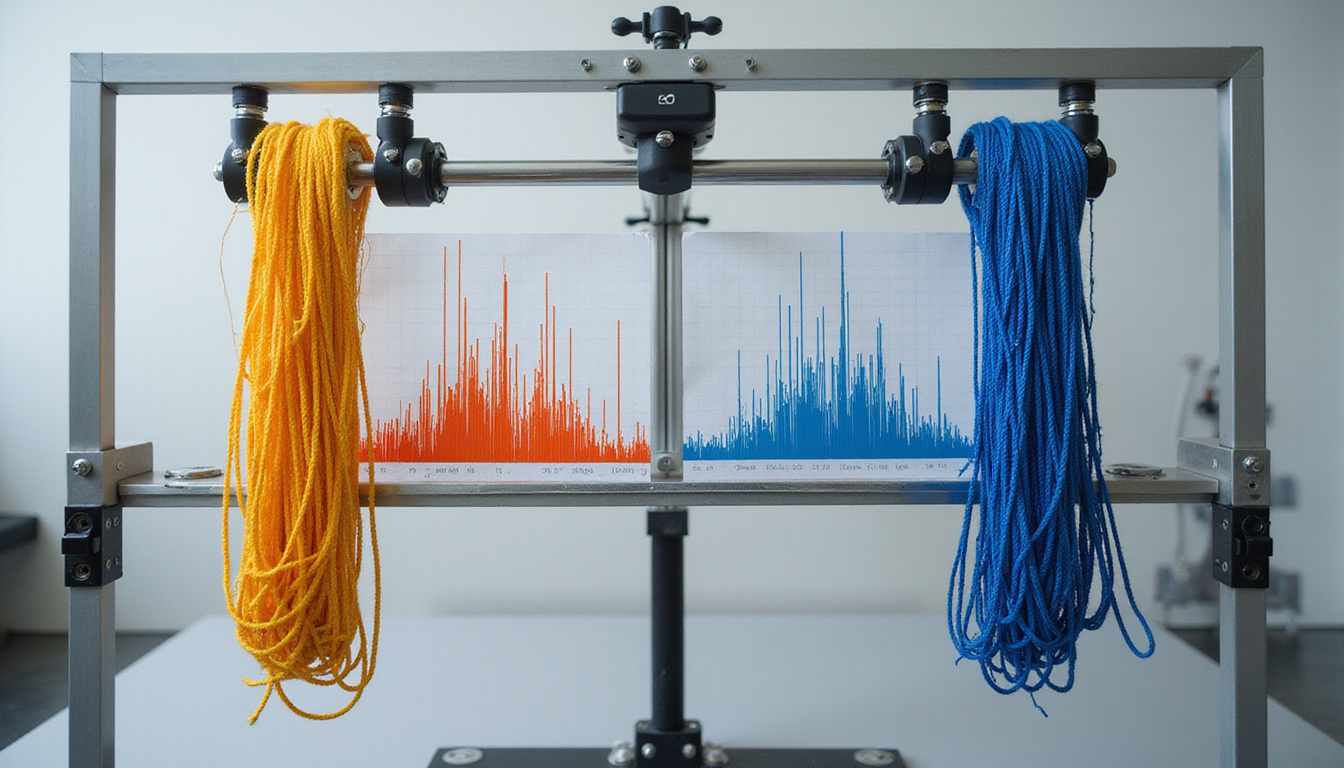
Construction Details that Change Bowstring Test Outcomes
Even with the same material, how a string is built makes a significant difference in performance tests.
Key construction variables include:
- Strand count – More strands generally mean stronger but heavier strings; fewer strands can add speed but may increase noise.
- Twist rate – Affects stability, peep rotation, and overall feel.
- Serving type and tension – Impacts durability, nock fit, and cam interface.
- Pre-stretch methods – Pre-stretched strings usually exhibit less creep and faster break-in during bowstring tests.
Two strings from different builders, both using the same material, can test very differently just because of these construction choices.
How to Run a Simple Bowstring Test Yourself
You don’t need a lab. With a bit of structure, you can conduct your own bowstring test at home or at the range.
Step 1: Define Your Testing Conditions
- Use the same bow, arrows, and broadheads/points.
- Keep draw weight and draw length identical between strings.
- Shoot in similar weather conditions as much as possible.
Step 2: Collect Basic Speed Data
- Use a chronograph.
- Shoot a warm-up group, then record 10 shots per string.
- Note average fps and how much the speeds vary.
Step 3: Track Tuning Stability
Over the first 200–300 shots:
- Monitor brace height and peep position.
- Note any needed adjustments to cam timing or nocking point.
- Record how many times you have to re-tune.
Step 4: Evaluate Noise and Feel
This is partly subjective, but you can make it more useful:
- Have a friend stand safely to the side and behind the target to listen.
- Note perceived vibration in the grip and riser.
- Try the same limb dampeners and string silencers on every test string.
Step 5: Measure Group Sizes
- Shoot groups at at least two distances (e.g., 20 and 50 yards).
- Measure the diameter of your best 5-shot groups.
- Repeat on different days to reduce shooter bias.
Step 6: Monitor Wear Over Time
- Take clear photos of the string every 200–300 shots.
- Look for serving separation, fuzzing, or flat spots at cam tracks.
- Compare how fast each string shows degradation.
Shocking Differences Often Seen in Bowstring Tests
Archers are frequently surprised by the magnitude of differences revealed by structured testing. Common findings include:
-
One string feels smoother but is 8–10 fps slower.
Depending on your goals (3D vs. hunting vs. target), that trade-off might be acceptable—or not. -
Premium doesn’t always mean best for you.
High-end materials with ultra-low creep can feel harsh or louder on some bows. -
Cheap strings cost you in tuning time.
Even if initial performance looks fine, rapid creep and peep rotation can force constant tinkering. -
Two similar bows can prefer different strings.
Limb geometry, cam design, and even grip style can make one string perform better on Bow A and another on Bow B. -
Humidity and temperature matter.
In more rigorous bowstring tests, strings sometimes show different stability behavior under extreme wet or cold conditions.
Interpreting Bowstring Test Results for Your Shooting Style
Raw numbers don’t tell the whole story. You need to weigh test outcomes against how and where you shoot.
For Bowhunters
- Prioritize quietness, stability, and reliability over a few extra fps.
- Look for strings that hold tune over long intervals and under varied weather.
- A slightly heavier, more stable string that resists creep can be a better choice than the absolute fastest option.
For Target and 3D Archers
- Consistency dominates: minimal speed variation and rock-solid peep alignment.
- If your bowstring test shows one string grouping 10–15% tighter at distance, that’s a strong sign.
- Noise is less critical, but vibration and comfort can affect shooting form over long rounds.
For Traditional Archers
- Pay attention to material compatibility with your bow.
- Dacron or other more forgiving options often win when limb longevity is paramount.
- Run simpler bowstring tests: arrow flight quality, hand shock, and real-world accuracy.
Basic Bowstring Maintenance to Preserve Test-Winning Performance
Even the best-performing string from your bowstring test will degrade quickly if neglected.
Follow these essentials:
- Wax regularly (but not to the point of buildup).
- Inspect before every shooting session for cuts, broken strands, and serving damage.
- Avoid prolonged sun and heat exposure, such as leaving your bow in a hot vehicle.
- Replace on schedule—many active archers swap hunting bowstrings every 1–2 years, even if they “look” fine.
A string that tested brilliantly six months ago can quietly become unsafe or unpredictable if maintenance slips.
FAQ: Bowstring Testing and Performance
Q1: How often should I run a bowstring test on my setup?
You don’t need a full bowstring test every month, but it’s smart to evaluate whenever you install a new string, change arrow setups, or notice unexplained changes in point of impact. At a minimum, run a quick speed and grouping check after any major string replacement.
Q2: What’s the best bowstring for accuracy in long-range shooting?
There is no single “best” bowstring, but bowstring tests consistently show that low-creep, well-constructed strings with proper pre-stretch and precise serving tend to deliver the tightest long-range groups. Focus on consistency of speed, minimal peep rotation, and stable cam timing rather than just raw velocity.
Q3: Are custom bowstrings worth it compared to stock strings?
Most structured bowstring tests indicate that quality custom strings outperform many stock options in stability, speed, and long-term tuning. If you shoot frequently, compete, or hunt seriously, the upgrade is often justified by better performance and fewer tuning headaches.
Turn Your Own Bowstring Test into Real-World Results
Your bow is only as consistent as the string driving it. Instead of guessing—or living with mystery flyers and drifting tune—use a simple, structured bowstring test to expose how different strings really perform on your setup. Measure speed, track stability, evaluate noise, and record group sizes. The data you collect will quickly highlight which string gives you the best blend of accuracy, comfort, and durability for your goals.
If you’re ready to unlock the full potential of your bow, start planning your first bowstring test now. Choose two or three candidate strings, document your process, and let real results—not marketing claims—guide your next upgrade. Your future groups, scores, and success in the field will reflect the effort you put in today.