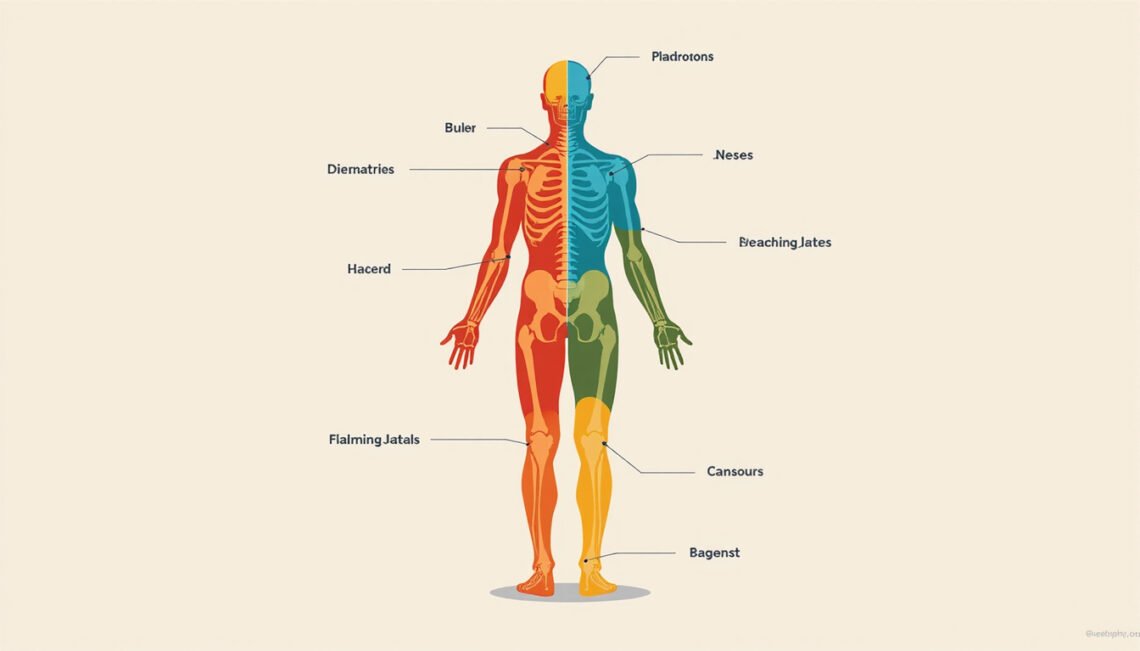
Dermatomes might sound like a complicated medical term, but the idea is surprisingly simple and extremely useful. In basic terms, dermatomes are skin zones supplied by specific spinal nerves. Understanding them helps explain why pain from the spine can show up in strange places—like down your leg or into your shoulder—even when the skin itself looks normal. This guide breaks down what dermatomes are, how they’re mapped, and what symptoms they can help you understand.
What Are Dermatomes?
A dermatome is an area of skin that’s mainly supplied by sensory fibers from a single spinal nerve root. Your spinal cord sends out pairs of nerves at each level of the spine (cervical, thoracic, lumbar, sacral). Each of these nerve roots collects sensation (touch, temperature, pain) from a strip or patch of skin.
Key points:
- Each spinal nerve root corresponds to one or more dermatomes.
- Sensory changes in a specific dermatome can indicate a problem at a particular spinal level.
- Doctors use dermatomal patterns to help localize nerve injuries and spinal conditions.
Dermatomes are especially important in neurology, orthopedics, pain medicine, and physical therapy, but they’re also useful for anyone trying to understand nerve-related pain and numbness.
The Spinal Nerve System Behind Dermatomes
To understand dermatomes, it helps to know the basic layout of your spinal nerves.
Your spine is divided into regions:
- Cervical (C1–C8) – neck area
- Thoracic (T1–T12) – upper and mid-back, chest
- Lumbar (L1–L5) – lower back
- Sacral (S1–S5) – pelvic region and back of the legs
- Coccygeal (Co1) – tailbone area
Each spinal nerve root exits the spinal cord at a specific level and then branches out to supply muscles and skin. The skin coverage area for a given root is its dermatome.
For example:
- C6 dermatome includes the thumb side of the forearm and hand.
- L5 dermatome includes the top of the foot and big toe.
- S1 dermatome includes the outer foot and small toe.
When a nerve root is irritated or compressed—such as in a herniated disc—the symptoms often follow the dermatome rather than staying just in the spine.
Major Dermatomes by Region
Cervical Dermatomes (C2–C8)
The cervical dermatomes mainly cover the head, neck, shoulders, and arms.
- C2 – back of the head and upper neck
- C3 – lower neck and area over the trapezius
- C4 – shoulder area and upper chest near the collarbone
- C5 – outer upper arm down to just above the elbow
- C6 – outer forearm, thumb, and side of the index finger
- C7 – middle of the forearm and middle finger
- C8 – ring and little finger, and inner forearm
Symptoms like neck pain with numbness in the thumb and index finger can suggest C6 involvement, while numbness in the middle finger might point to C7.
Thoracic Dermatomes (T1–T12)
The thoracic dermatomes wrap around the chest and abdomen in horizontal bands.
- T1 – inner upper arm
- T2 – upper chest and armpit area
- T3–T6 – upper to mid-chest region
- T7–T9 – upper to mid-abdomen
- T10 – level of the belly button (umbilicus)
- T11–T12 – lower abdomen and top of pelvis
Shingles often follows a single thoracic dermatome, causing a stripe of painful rash around one side of the chest or abdomen.
Lumbar Dermatomes (L1–L5)
The lumbar dermatomes cover much of the front of the legs and part of the lower back.
- L1 – groin area and upper inner thigh
- L2 – mid-thigh (front)
- L3 – lower thigh and inner knee
- L4 – front of the knee and inner lower leg to the ankle
- L5 – outer lower leg, top of the foot, and big toe
Low back issues that pinch the L4 or L5 nerve roots often cause pain and tingling that travel from the back down the leg in these patterns, commonly called radiculopathy or “sciatica”-like symptoms.
Sacral Dermatomes (S1–S5 and Co1)
The sacral dermatomes cover the back of the legs, buttocks, and genital area.
- S1 – back of the calf, outer foot, and little toe
- S2 – back of the thigh and upper calf
- S3 – buttock and inner thigh near the groin
- S4–S5 – areas around the anus and perineum
- Co1 – skin over and around the tailbone
These dermatomes are important when assessing conditions affecting the sacral nerve roots, such as severe disc herniations, spinal stenosis, or certain spinal cord injuries.
How Dermatome Maps Are Used Clinically
Doctors and therapists use dermatome maps like a “nerve GPS” to pinpoint where a problem may be coming from. When a patient describes pain, tingling, or numbness, the pattern can guide the examination.
Common clinical uses of dermatomes:
-
Diagnosing radiculopathy:
Pain radiating from the neck into the thumb and index finger suggests C6; low back pain radiating to the big toe suggests L5. – Evaluating disc herniations:
A herniated disc at L4–L5 is likely to affect the L5 nerve root, often matching the L5 dermatome. -
Checking spinal cord injuries:
Testing sensation in various dermatomes helps determine the level of a spinal cord lesion. -
Planning regional anesthesia:
Anesthesiologists use dermatomes to ensure the right skin areas are numbed during procedures, such as epidurals. -
Diagnosing shingles (herpes zoster):
The viral rash typically appears in a single dermatome, often on one side of the torso or face (source: CDC).
Dermatome patterns aren’t perfect, but they provide a very useful starting point for figuring out what’s going on with nerve-related symptoms.
Typical Symptoms Along Dermatomes
When a nerve root is irritated, inflamed, or compressed, you can experience specific symptoms in its dermatome. These symptoms can vary from mild to severe.
Common dermatome-related symptoms:
- Pain – sharp, burning, electric, or aching feeling down a specific pathway
- Numbness – loss of feeling in a patch of skin
- Tingling or “pins and needles” – abnormal sensations (paresthesia)
- Increased sensitivity – even light touch can feel very painful
- Reduced sensation – dull or absent feeling when the skin is touched
For example:
- C7 nerve irritation: pain that travels from the neck into the middle finger, sometimes with weakness in triceps.
- L5 nerve root compression: pain starting in the lower back, radiating to the outer leg and big toe, sometimes with trouble lifting the foot (foot drop).
Because the skin, nerve, and spinal cord are all parts of one system, following these dermatome patterns can reveal a lot about where the problem truly is.
How Dermatome Testing Is Done
In a physical or neurologic exam, clinicians test dermatomes using simple tools and techniques:
- Light touch: Using a cotton ball or finger to see if you feel touch equally on both sides.
- Pinprick: Using a safety pin or similar to check pain sensation.
- Temperature: Sometimes warm/cool objects are used if sensation changes are subtle.
- Vibration: A tuning fork can check how vibration is perceived in certain areas.
- Comparison: The same dermatome on the left and right sides is compared.
By asking “Does this feel the same as on the other side?” in various dermatomes, clinicians can map out where sensation is reduced or altered, then link it back to specific spinal nerve roots.

Limitations: Why Dermatomes Aren’t Exact
Dermatome diagrams are incredibly helpful, but they’re simplified approximations. In real life:
- There is overlap between neighboring dermatomes; boundaries are not razor-sharp.
- People vary; individual nerve patterns can differ slightly from textbook maps.
- Some nerves mix together in plexuses (like the brachial plexus in the arm), making patterns more complex.
- Symptoms can be mixed; muscle weakness and reflex changes also need to be considered, not just skin sensation.
This is why clinicians combine dermatome findings with other exam elements—like muscle testing, reflexes, and imaging—rather than relying on dermatomes alone.
Practical Examples: When Dermatome Knowledge Helps
Understanding dermatomes can help you make sense of your own symptoms and communicate clearly with healthcare providers.
Examples:
-
Arm pain and numbness:
- Numbness in the thumb and index finger = often C6 dermatome.
- Numbness in the middle finger = often C7.
- Numbness in the ring and little finger = often C8 or ulnar nerve.
-
Leg pain (sciatica-type):
- Pain down the back of the leg into the outer foot and little toe = S1 dermatome.
- Pain down the side of the leg into the top of the foot and big toe = L5. – Shingles rash pattern:
A band of blisters on one side of the chest, not crossing the midline, commonly matches a single thoracic dermatome (e.g., T5 or T6).
In each case, the dermatome pattern gives a strong clue about which nerve root may be involved.
Quick Reference List of Key Dermatomes
Here’s a simplified overview of some commonly referenced dermatomes:
- C2: Back of head and upper neck
- C4: Top of shoulders and collarbone area
- C5: Outer upper arm
- C6: Thumb side of forearm and hand
- C7: Middle finger
- C8: Ring and little fingers
- T4: Level of the nipples
- T10: Level of the belly button
- L1: Groin
- L3: Knee (front and inner side)
- L4: Inner lower leg and ankle
- L5: Top of foot and big toe
- S1: Outer foot and little toe
- S3–S5: Buttock and perineal area (saddle region)
Remember that diagrams in textbooks or online will show these zones visually, which can be even easier to understand than text descriptions alone.
FAQ About Dermatomes and Nerve Maps
1. What are dermatomes in the human body, and why do they matter?
Dermatomes in the human body are specific skin areas supplied by individual spinal nerve roots. They matter because patterns of pain, numbness, or tingling that follow dermatomal lines can help identify where a nerve is irritated or compressed, guiding diagnosis and treatment.
2. How do doctors use a dermatome map for diagnosis?
Doctors use a dermatome map to compare your symptoms with known nerve distributions. If you report tingling in the thumb and index finger, they’ll think of the C6 dermatome and examine your neck and corresponding nerve root. By matching symptoms to the dermatome chart, they can better localize radiculopathy, spinal cord injuries, or conditions like shingles.
3. What’s the difference between dermatomes and myotomes?
Dermatomes are skin areas supplied by sensory fibers of a spinal nerve root, while myotomes are groups of muscles supplied by motor fibers of that root. Dermatome testing checks sensation on the skin; myotome testing checks muscle strength and movement. Both help build a full picture of nerve function.
Take the Next Step: Turn Knowledge into Action
If you recognize your own symptoms following one of these dermatomes—such as radiating arm or leg pain, numbness in a specific skin zone, or a band-like rash—it’s a signal worth paying attention to. Understanding dermatomes can help you describe your symptoms more clearly, but it’s not a substitute for a professional exam.
If you’re dealing with persistent nerve-like pain, tingling, or numbness:
- Note exactly where the symptoms appear on your skin.
- Pay attention to what makes them better or worse.
- Share this information and, if possible, a dermatome map with your healthcare provider.
Early evaluation can lead to more effective treatment and may prevent nerve damage from getting worse. Use what you now know about dermatomes to be an informed partner in your own care—and don’t wait to seek help if your symptoms are interfering with your daily life.