
Sciatica Workout: 7 Safe Exercises That Stop Sciatic Pain Quickly
If you live with shooting leg pain, numbness, or tingling from your lower back down to your foot, a targeted sciatica workout can be one of the safest and fastest ways to get relief. The right movements help calm irritated nerves, loosen tight muscles, and build support around your spine so the pain doesn’t keep coming back.
Below you’ll find seven safe, beginner-friendly exercises that are commonly recommended by physical therapists for sciatic pain. Always check with your healthcare provider first, especially if your pain is severe, you’ve recently had surgery, or you have other medical conditions.
Understanding Sciatica (and Why Exercise Helps)
Sciatica is a symptom, not a disease. It typically happens when the sciatic nerve is compressed or irritated—most often by:
- A lumbar disc herniation or bulge
- Spinal stenosis (narrowing of the spinal canal)
- Piriformis syndrome (tight hip muscle compressing the nerve)
- Degenerative changes in the spine
Symptoms can include:
- Sharp, shooting pain from the lower back/buttock down the leg
- Burning, tingling, or “pins and needles”
- Numbness or weakness in the leg or foot
A well-designed sciatica workout helps by:
- Reducing pressure on the sciatic nerve
- Improving flexibility in tight muscles (hips, hamstrings, piriformis)
- Strengthening core and glute muscles that stabilize your spine
- Promoting blood flow and healing
According to clinical guidelines, staying active with guided exercise is often more effective in the long run than bed rest for low back and sciatic pain (source: American Academy of Orthopaedic Surgeons).
Before You Start: Safety Tips for a Sciatica Workout
Before jumping into the exercises, keep these guidelines in mind:
- Stop immediately if you feel sharp, worsening, or electric shock–like pain.
- Move slowly and avoid bouncing or jerking.
- Breathe normally; don’t hold your breath.
- Aim for comfort, not intensity—mild stretch or muscle effort is enough.
- Consult a professional if you have significant weakness, bowel/bladder changes, or unexplained weight loss—these can signal a more serious condition.
Exercise 1: Modified Child’s Pose (Gentle Low Back Decompression)
This simple yoga-inspired move gently lengthens the lower back and helps open the hips, providing relief for many types of sciatic pain.
How to do it
- Kneel on a mat with your knees about hip-width apart, toes touching behind you.
- Sit back toward your heels. If this hurts your knees, put a pillow between your thighs and calves.
- Slowly lower your torso forward, walking your hands out in front of you.
- Rest your forehead on the mat or on a cushion.
- Breathe deeply, relaxing your shoulders and lower back.
Time & reps: Hold for 20–30 seconds. Repeat 3–5 times.
Make it easier: Spread your knees wider or place your hands on a chair or couch to keep your torso higher.
Exercise 2: Piriformis Stretch (Targeted Hip Release)
The piriformis is a small muscle deep in your buttock that lies over the sciatic nerve. When it gets tight, it can compress the nerve and mimic or worsen sciatica. This stretch is a staple of any effective sciatica workout.
How to do it (lying version)
- Lie on your back with your knees bent, feet flat on the floor.
- Cross your right ankle over your left thigh, just above the knee (“figure 4” position).
- Grab the back of your left thigh with both hands.
- Gently pull your left leg toward your chest until you feel a stretch in your right buttock/hip.
- Keep your head and shoulders relaxed on the floor.
Time & reps: Hold 20–30 seconds, 2–3 times per side.
Tip: You should feel a deep stretch in the buttock, not pain radiating down the leg. Ease off if the nerve symptoms increase.
Exercise 3: Hamstring Stretch with Strap
Tight hamstrings can tug on your pelvis and aggravate lower back and sciatic issues. Stretching them correctly—without rounding your back—is essential.
How to do it
- Lie on your back with both legs extended.
- Loop a strap, belt, or towel around the ball of your right foot.
- Keeping your right knee slightly bent, gently lift the leg toward the ceiling.
- Pull on the strap until you feel a stretch along the back of your thigh.
- Keep your lower back flat, not arched.
Time & reps: Hold 20–30 seconds, 2–3 times per leg.
Common mistake: Don’t force the leg straight. A soft bend in the knee is safer and still effective.
Exercise 4: Pelvic Tilts (Gentle Core Activation)
Strong, coordinated core muscles support your spine and reduce pressure on the sciatic nerve. Pelvic tilts are a safe starting point for core work in a sciatica workout.
How to do it
- Lie on your back with knees bent, feet hip-width apart.
- Place your hands on your hips or lower abdomen.
- Inhale. As you exhale, gently tighten your lower abdominal muscles and flatten your lower back into the floor. Imagine tucking your tailbone slightly.
- Hold this tucked pelvis for 3–5 seconds while breathing normally.
- Relax and let your back return to neutral (small natural curve).
Reps: 10–15 repetitions, 1–2 sets.
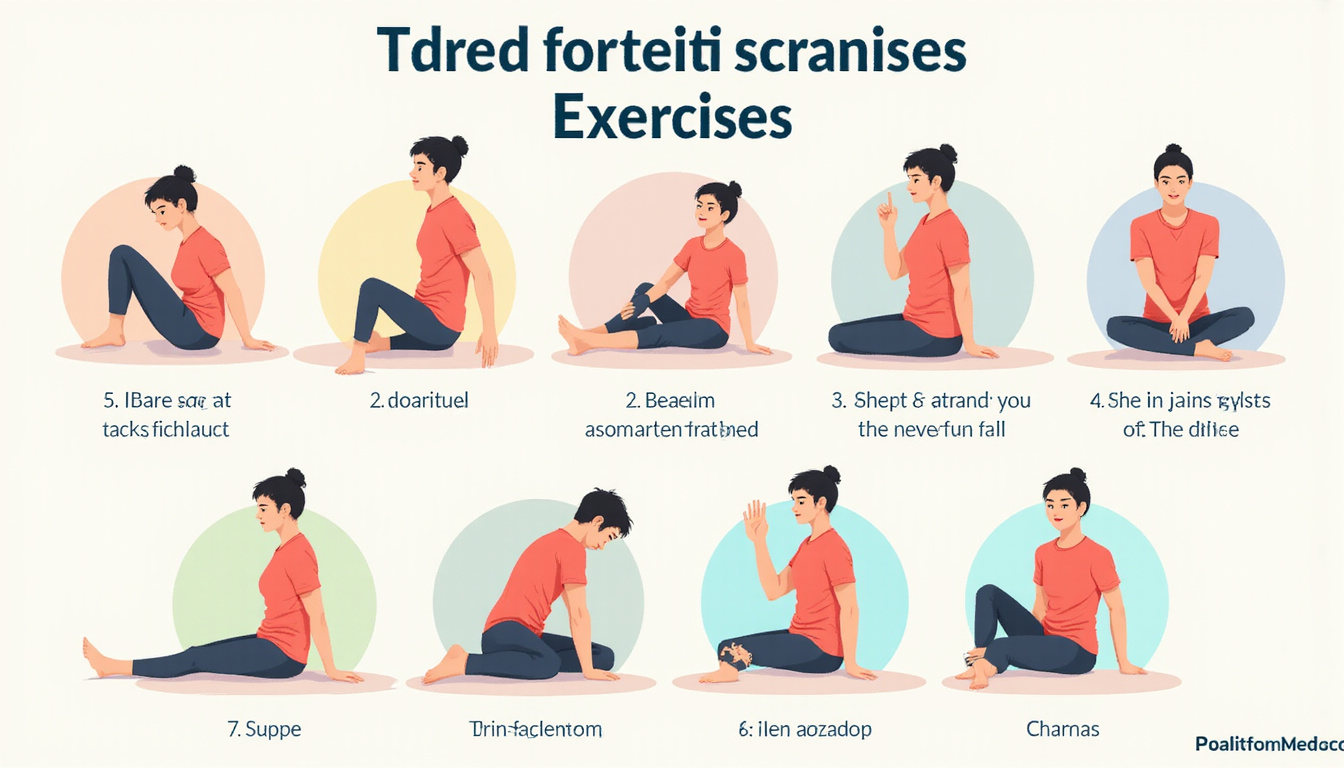
Progression: Once this feels easy, you can add small marches—lifting one foot a few inches and alternating—while maintaining the pelvic tilt.
Exercise 5: Glute Bridge (Hip and Glute Strengthener)
Weak glutes force your lower back to do extra work, which can worsen sciatica. Glute bridges strengthen the buttock muscles and posterior chain while keeping your spine supported.
How to do it
- Lie on your back with knees bent and feet flat, hip-width apart.
- Engage your core (light pelvic tilt) to protect your lower back.
- Press through your heels and squeeze your glutes to lift your hips off the floor.
- Lift until your shoulders, hips, and knees form a straight line—avoid arching your lower back.
- Hold 2–3 seconds at the top, then slowly lower down.
Reps: 10–12 repetitions, 2–3 sets, with 30–60 seconds rest between sets.
Make it easier: Don’t lift as high at first. Focus on glute squeeze more than height.
Exercise 6: Cat-Cow Stretch (Spine Mobility)
This dynamic stretch increases flexibility in the spine without heavy loading, making it an ideal addition to a sciatica workout for many people.
How to do it
- Start on all fours with wrists under shoulders and knees under hips.
- As you inhale, gently arch your back, lifting your tailbone and chest toward the ceiling (cow). Look slightly up without crunching your neck.
- As you exhale, round your spine toward the ceiling, tucking your tailbone and bringing your chin toward your chest (cat).
- Move smoothly between these positions, coordinating with your breath.
Reps: 8–12 slow cycles.
Tip: Focus on a pain-free range of motion. The movement should feel like a gentle massage for your spine, not a strain.
Exercise 7: Sciatic Nerve Glide (Nerve Mobilization)
Nerve glides—also called “neural flossing”—help the sciatic nerve move more freely through surrounding tissues. When done gently, they can reduce sensitivity and improve range of motion.
How to do it (seated version)
- Sit upright on a chair with both feet flat on the floor.
- Slowly extend your right knee so your leg straightens in front of you.
- As you straighten the leg, gently pull your toes toward you (dorsiflex the ankle).
- At the same time, look up slightly (not a big head tilt).
- Then reverse: bend the knee, relax the ankle (toes away), and gently look down.
- Move rhythmically without holding at the end of the motion.
Reps: 8–10 repetitions per leg.
Important: This should feel like a mild stretch or gentle pulling—not burning, sharpness, or a big increase in sciatic symptoms. Stay well within your comfort zone.
Putting It All Together: A Sample Daily Sciatica Workout
Here’s how you might combine these seven exercises into a short routine. Adjust based on your comfort and your doctor’s advice.
-
Warm-up (2–3 minutes)
- Easy walking around your home or gentle marching in place.
-
Mobility and stretching (8–10 minutes)
- Cat-Cow: 8–12 cycles
- Modified Child’s Pose: 3 x 20–30 seconds
- Piriformis Stretch: 2–3 x 20–30 seconds per side
- Hamstring Stretch with Strap: 2 x 20–30 seconds per side
-
Strength and activation (8–10 minutes)
- Pelvic Tilts: 10–15 reps
- Glute Bridges: 2–3 sets of 10–12 reps
- Sciatic Nerve Glides: 8–10 reps per leg
-
Cool-down (2–3 minutes)
- Gentle walking and slow, deep breathing.
Aim to do this sciatica workout 3–6 days per week, depending on your symptoms and energy level.
When to Modify or Avoid a Sciatica Workout
Not every movement is right for every person. You should stop and consult a professional if:
- Pain suddenly worsens or changes character
- You develop noticeable leg weakness or foot drop
- You lose bladder or bowel control (emergency—seek immediate medical care)
- Numbness, tingling, or burning dramatically increase during or after exercise
If you work at a desk or drive a lot, also consider lifestyle adjustments: better chair support, frequent standing breaks, and avoiding sitting on a thick wallet in your back pocket, which can irritate the nerve.
FAQ: Sciatica Workouts and Pain Relief
1. What is the best exercise for sciatica pain relief at home?
There is no single “best” exercise, but many people find a combination of piriformis stretching, hamstring stretching, and gentle core strengthening (like pelvic tilts and glute bridges) most helpful. A balanced sciatica workout that includes mobility, stretching, and strength is usually more effective than any one move alone.
2. How often should I do sciatica exercises?
In many cases, daily or near-daily practice works best—especially for gentle stretches and nerve glides. Strength exercises (like glute bridges) can be done 3–4 times per week. Listen to your body; mild muscle soreness is OK, but increased nerve pain is a sign to back off and seek guidance.
3. Can a sciatica exercise program make my symptoms worse?
Yes, if the exercises are too intense, performed with poor form, or not appropriate for your specific condition, sciatic pain can worsen. That’s why it’s important to start gently, avoid movements that sharply increase your symptoms, and get clearance from a healthcare provider before beginning any new sciatica workout plan, especially if your pain is severe or long-standing.
Take the Next Step Toward Living Pain-Free
Sciatic pain can feel overwhelming, but you’re far from powerless. By consistently practicing a safe, well-structured sciatica workout, you can reduce pressure on the nerve, calm irritated tissues, and build the strength that keeps your back and hips stable for the long term.
Start with just a few of the exercises above today—maybe the modified child’s pose, piriformis stretch, and pelvic tilts—and notice how your body responds. Then gradually build toward the full routine as your pain allows.
If you want faster, more personalized results, consider working with a physical therapist or qualified movement professional who can tailor a sciatica exercise program to your unique body and lifestyle. Take action now: commit to a 10–15 minute daily routine this week, and begin reclaiming your mobility, comfort, and confidence—one safe, deliberate movement at a time.