Isokinetic exercise is one of the most powerful yet underused tools for building strength, speeding up rehab, and reducing injury risk. While most people focus on free weights or machines that use fixed loads, isokinetic training uses controlled speed to safely push your muscles to their true potential. Whether you’re an athlete, recovering from injury, or simply want smarter, more efficient workouts, understanding how isokinetic exercise works can transform the way you train.
What is isokinetic exercise?
Isokinetic exercise is a type of strength training where the speed of movement stays constant throughout the range of motion, while the resistance automatically adjusts to match your effort.
- “Iso” = same
- “Kinetic” = movement
So instead of lifting a fixed weight (like a dumbbell), you push or pull against a specialized machine that moves at a set speed. No matter how hard you push, the machine keeps the speed the same—but increases or decreases resistance in real time to match your force.
This means:
- When you push harder, the machine “fights back” with more resistance.
- When you get tired and push less, the resistance drops automatically.
The result is highly controlled, safe, and efficient muscular work that can be tailored precisely to your strength and rehab needs.
How isokinetic training differs from other strength methods
To understand the value of isokinetic exercise, it helps to compare it with the two more familiar types of muscle contractions:
Isotonic exercise
- Definition: Resistance stays the same, speed can change.
- Example: Lifting a dumbbell, leg press, squats.
- Reality: The weight is constant, but your speed and tension vary throughout the movement. It’s harder at certain joint angles and easier at others.
Isometric exercise
- Definition: Muscle tension increases, but joint angle does not change (no movement).
- Example: Plank hold, wall sit, pushing against an immovable object.
Isokinetic exercise
- Definition: Speed stays constant, resistance changes to match your force output.
- Example: Pushing against an isokinetic dynamometer arm that spins at a preset speed.
Unlike isotonic lifting, where momentum and leverage affect how hard a rep feels, isokinetic training precisely controls speed and matches resistance. This allows for:
- Maximal effort through the entire range of motion
- Detailed measurement of force, power, and endurance
- Symmetry testing between limbs to spot imbalances
How isokinetic exercise works (in simple terms)
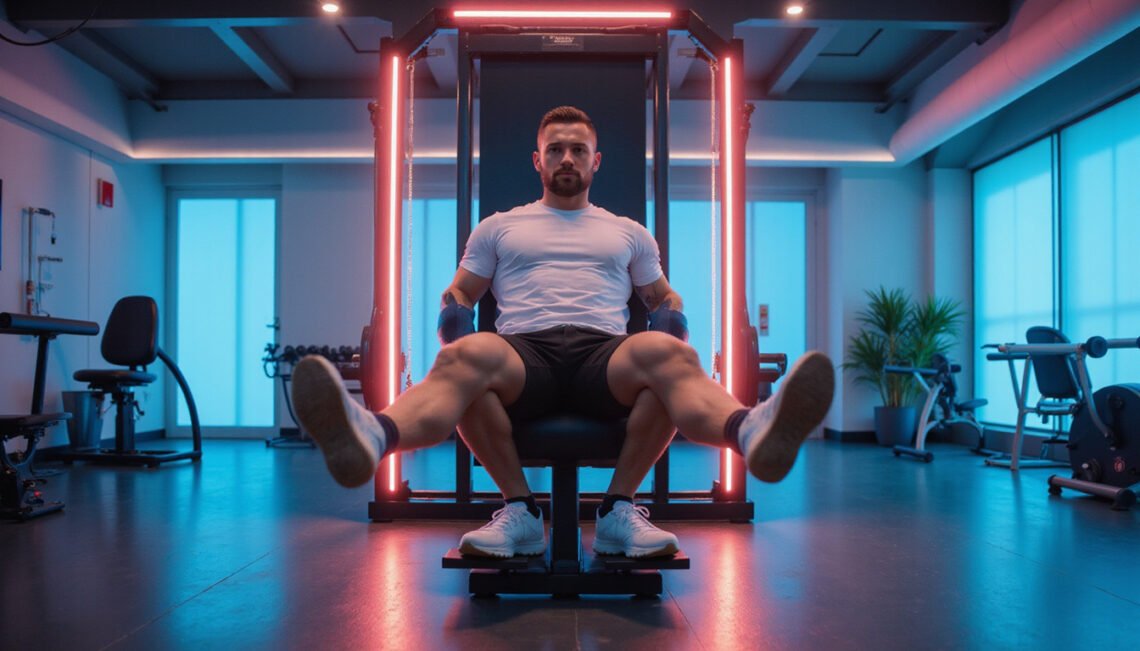
Isokinetic training typically uses a motorized machine called an isokinetic dynamometer. You’re strapped in to stabilize your body, then you perform a movement—like knee extension, elbow flexion, or shoulder rotation—against a lever or arm.
The machine is set to a constant angular speed, such as:
- 60°/second (slow, max strength focus)
- 120°/second (moderate)
- 180–300°/second (faster, power and endurance focus)
As you push or pull:
- The machine keeps the movement speed constant.
- Sensors measure how much force you produce at each angle.
- Resistance is automatically adjusted so that you can give maximum effort safely, without the risk of momentum or uncontrolled acceleration.
In rehab and sports labs, clinicians use these measurements to assess strength, power, and deficits between injured and healthy limbs.
Key benefits of isokinetic exercise
1. Faster, safer rehabilitation
Isokinetic exercise has long been a gold standard in physical therapy and sports medicine, especially after:
- ACL reconstruction
- Meniscus or ligament injuries
- Rotator cuff surgeries
- Major joint injuries
Benefits for rehab include:
- Controlled loading: Speed is limited, reducing the risk of re-injury.
- Adaptive resistance: If you’re weak or fatigued mid-rep, the resistance drops with you.
- Objective progress tracking: Machines record force data, making it easy to see true improvements.
Research supports isokinetic training as a highly effective method for restoring strength and function after knee injuries and surgeries (source: National Institutes of Health).
2. Greater strength gains across the full range of motion
Traditional weights challenge you most only at certain angles. For example, a biceps curl is hardest in the middle and easier at the top and bottom.
With isokinetic training:
- You can generate maximum effort at every angle, not just at the “sticking point.”
- This leads to more even strength development and better joint control.
- Both concentric (shortening) and eccentric (lengthening) muscle actions can be trained precisely.
Athletes often use isokinetic training in targeted phases to break through plateaus and iron out weak spots.
3. Improved power and speed
Because you can set high movement speeds (e.g., 240–300°/second), you can train for:
- Explosive power
- Sport-specific speed
- Rate of force development (how fast you can generate force)
This matters in sports like:
- Soccer and basketball (cutting, jumping, sprinting)
- Baseball and tennis (rotational power, arm speed)
- Track and field (starts, explosive leg drive)
Isokinetic machines let you safely train at high speeds that are difficult to replicate with free weights without risking joint strain.
4. Reduced risk of overload and compensation
Because the resistance adapts instantly:
- There’s less risk of overloading a weak or healing structure.
- You can isolate specific joints or muscle groups while stabilizing the rest of the body.
- The machine can identify when one side is compensating for the other.
This precision is particularly valuable after injuries where the body tries to “cheat” by shifting load away from a weaker limb.
Who can benefit most from isokinetic exercise?
1. Post-injury and post-surgery patients
If you’re recovering from:
- Knee surgery (ACL, meniscus, total knee replacement)
- Shoulder repairs (rotator cuff, labrum)
- Major ligament sprains
- Tendon repairs
Isokinetic testing and training can:
- Set safe baselines for loading
- Guide return-to-sport decisions
- Identify lingering strength deficits that might increase reinjury risk
2. Competitive and recreational athletes
Athletes use isokinetic exercise to:
- Analyze right vs. left limb strength
- Build sport-specific power and endurance
- Prepare for return to play after injury with objective clearance criteria
Even recreational athletes benefit by targeting weak links and addressing imbalances that may not show up with traditional gym tests.
3. Older adults and people with joint issues
For individuals with:
- Osteoarthritis
- Joint instability
- Balance or movement confidence issues
Isokinetic training offers:
- Highly controlled movement
- Joint-friendly resistance that adapts to comfort levels
- A safe way to build strength and function without heavy external weights
Common examples of isokinetic exercises
Most isokinetic exercises are done with large clinical or sports performance machines, but the underlying movements are familiar:
- Knee extension and flexion: Strengthening quadriceps and hamstrings.
- Ankle plantarflexion/dorsiflexion: Calf and shin muscles, useful post-ankle injuries.
- Shoulder internal and external rotation: Rotator cuff training for throwers and overhead athletes.
- Elbow flexion and extension: Biceps and triceps assessment and strengthening.
- Hip flexion, extension, abduction, adduction: Critical for runners and field sport athletes.
Each movement is performed at preset speeds and often at multiple velocities within a testing or training session.
What a typical isokinetic training session looks like
A supervised isokinetic training session often follows a structured pattern:
-
Warm-up
- Light cardio (5–10 minutes)
- Dynamic stretching and activation
-
Setup and alignment
- You’re positioned on the machine so the joint’s axis of rotation matches the machine’s axis.
- Straps secure the body to minimize compensation.
-
Familiarization reps
- A few test movements at low intensity to get used to the device.
-
Work sets
Typically:- Several sets at a slow speed (e.g., 60°/s) for max strength
- Additional sets at higher speeds (120–300°/s) for power or endurance
- Reps are often timed or counted (e.g., 3 sets of 10, or max reps in 30 seconds).
-
Cool-down and review
- Light stretching
- Review of performance metrics (peak torque, average power, fatigue index).
Pros and cons of isokinetic exercise
Advantages
- Highly precise and measurable: Objective strength profiles for each joint angle and speed.
- Adaptive resistance = safer effort: Resistance rises and falls with your force.
- Great for rehab: Especially post-surgery or after major injury.
- Can target power, endurance, and strength in one system.
Limitations
- Equipment cost and access: Most machines are found in clinics, hospitals, and sports labs, not typical home gyms.
- Less “functional” variety: Movements are often single-joint and seated; they don’t fully mimic complex, real-world movements.
- Requires trained supervision: Proper setup and programming are important for safety and accuracy.
Because of these constraints, isokinetic exercise is usually supplemental to (not a replacement for) traditional strength and functional training.
How to incorporate isokinetic exercise into your training or rehab
If you have access through a clinic, university lab, or sports performance center, here’s a simple framework:
-
Start with an isokinetic assessment
- Test key joints (often knees and shoulders) at multiple speeds.
- Identify strength deficits (side-to-side differences >10–15% can be meaningful).
-
Target weak links
Use isokinetic sessions to focus on:- Rebuilding strength in an injured limb
- Improving power at sport-relevant speeds
- Reducing asymmetries that might predispose you to injury
-
Combine with traditional training
- Keep doing compound lifts (squats, deadlifts, presses), plyometrics, and mobility work.
- Use isokinetic work 1–2 times per week as a precision tool rather than your only training method.
-
Progress systematically
- Gradually increase speeds, total work, or number of sets.
- Use periodic re-testing to validate gains and adapt your program.
Simple list: When isokinetic exercise makes the most sense
Use isokinetic training especially when:
- You’re recovering from knee or shoulder surgery.
- You need objective data to decide when to return to sport.
- You have chronic strength imbalances between limbs.
- You’re an athlete aiming to fine-tune power and joint control.
- You’re an older adult needing safe, controlled strengthening with close supervision.
FAQ about isokinetic exercise and related concepts
1. What is isokinetic exercise used for in rehab?
Isokinetic exercise in rehabilitation is primarily used to measure and rebuild strength safely after injuries or surgeries. It helps clinicians track progress, detect weaknesses, and design precise programs to restore knee, shoulder, hip, or ankle function before returning to full activity.
2. How is isokinetic training different from isotonic training?
Isokinetic vs isotonic exercise comes down to what stays constant. In isotonic training, the weight stays constant but speed varies, like lifting a dumbbell. In isokinetic training, the speed stays constant while resistance changes to match your force. This allows for safer maximal effort and more accurate strength assessment.
3. Are isokinetic exercises good for athletes and not just for rehab?
Yes. Isokinetic exercises for athletes are valuable for testing right-left imbalances, developing power at sport-specific speeds, and reducing injury risk. While they’re heavily used in rehab settings, high-level sports programs also rely on isokinetic testing and training to guide conditioning and return-to-play decisions.
Take the next step: put isokinetic exercise to work for you
You don’t need to abandon your current training to benefit from isokinetic exercise—you just need to add it where it matters most. If you’re returning from injury, stuck at a performance plateau, or worried about lingering weakness or imbalances, isokinetic assessment and training can give you precise answers and a targeted path forward.
Look for a sports medicine clinic, physical therapy center, or performance lab in your area that offers isokinetic testing. Ask how they integrate isokinetic exercise into rehab or athletic programs. By combining this technology with smart, functional strength work, you can unlock faster recovery, safer progress, and greater strength gains than ever before.